Most college students walk into their first job interview having never practiced out loud. University career centers have limited appointments, private coaching costs $150 to $300 per hour, and self-directed prep through YouTube or forums lacks the one thing research shows actually builds skill: practice with feedback.
The result is a preparation gap rooted not in knowledge but in access. Students who practice perform better, not because they are more capable, but because they have rehearsed. Those without access to that practice are at a measurable disadvantage regardless of their qualifications.
Interview anxiety makes this worse. Research shows anxiety degrades performance directly, causing faster speech, more filler words, less structured responses, and difficulty recalling prepared examples. The students who need the most practice are the ones with the least access to it.
Problem Statement
Students don't need more information about how to interview well. What is missing is a space to practice speaking their answers, make mistakes without consequence, and receive specific feedback on how to improve.
What made this hard
Designing for anxious users is fundamentally different from designing for confident ones. Anxiety is not an external factor users bring to the product. It is shaped by every decision the interface makes. The number of choices presented, the tone of copy, the presence or absence of reassurance, and the visual weight of feedback all either reduce or amplify how a student feels. This was the core design constraint, equal in importance to any functional requirement.


Before building anything, the team ran an extensive validation process: a survey of 22 participants, 4 in-depth interviews, and an analog prototype test with 5 students. The goal was to understand whether the problem we identified resonated with real users.
The clearest insight from early research was a distinction about who needed this most. Students who had already navigated interviews found the idea interesting but not essential. The students who stood to benefit most were those facing interviews for the first time, including graduate students entering the workforce after years in academic environments. These students were not underprepared because they lacked knowledge. They had simply never practiced speaking their answers aloud in a realistic setting.
Three patterns came up consistently:
Anxiety started before the tool did
Students reported feeling nervous the moment they knew they were being assessed. This meant the product had to manage anxiety from the first screen, not just during the recording.
Language like "behavioral" and "technical" was unfamiliar
Interview jargon created a barrier before students had even started. Category names needed to feel approachable, not corporate.
Actionable feedback mattered more than comprehensive feedback
Students did not want a score or a list of 10 things to fix. They wanted one or two specific, grounded observations tied to what they actually said.


Existing tools like Yoodli, Orai, and Speeko dominated the interview prep space but shared a consistent gap: they were designed for users who already knew how to interview. They evaluated delivery without teaching structure. They recorded and replayed video, which added self-consciousness rather than reducing it. They provided numerical metrics that felt like grades rather than coaching.
None of them were designed for the student who had never practiced before.
Why CARL over STAR
Most interview prep tools reference the STAR framework (Situation, Task, Action, Result). Orato uses CARL (Context, Action, Result, Learning) because CARL's explicit Learning component is better suited to students with limited professional experience. Where STAR concludes with the outcome, CARL asks what you took away from it, signaling growth and self-awareness to recruiters. For a student whose experience includes class projects, campus roles, and part-time work, reflection is a more accessible differentiator than measurable achievement.

Orato was built across three iterative cycles between January and May 2026, each version directly informed by user testing findings.
V1: Feature Exploration (February 2026)
The first version tested the core flow: consent, mode selection, question preview, recording, feedback. The interface was dark and corporate, intentionally minimal to isolate whether the interaction model worked before investing in visual design. User testing with 3 participants produced a clear finding: video recording and eye tracking increased anxiety rather than reducing it. Students focused on their own appearance on screen instead of their answers. Both features were removed entirely. The product narrowed to voice-first interaction.
V2: Framework Introduction (March 2026)
V2 introduced CARL examples before recording, quote-based feedback, a session timer, and a camera-optional clarification. Testing with 2 participants revealed that numerical metrics like filler word counts felt punitive. One participant rated her anxiety at 5 out of 5 during the recording screen. The dark corporate interface was described as "too robotic." The setup flow asked too many decisions in rapid succession, creating decision fatigue before users had even started practicing.

V3: Visual and Emotional Redesign (April 2026)
V3 abandoned the dark interface entirely. Warm backgrounds, expressive typography, and illustrated team characters replaced clinical restraint with personality. A "Ready to record?" confirmation screen was added before the countdown. CARL examples used student-relevant scenarios like club leadership, class projects, and hackathons instead of professional corporate ones. Metric pills were replaced with qualitative indicators: "Just right," "A bit rushed." A progress bar was added during AI processing. Anxiety ratings dropped measurably across all V3 testing sessions.

V3 established the first formalized design system applied consistently across the product. Earlier versions had made interface decisions screen by screen without a shared system.
Typography
A handwritten display typeface for headers paired with Plus Jakarta Sans for body text and feedback content. The combination was designed to feel approachable and warm without sacrificing legibility.
Color palette
Primary purple for interactive elements, secondary cream for warmth, dark text, and a warm cream background. Functional colors: green for strengths, orange for cautionary feedback, and red for high filler word warnings.
Spacing and components
Standardized across all states with particular attention to button scale and feedback layout, both identified in earlier testing as sources of confusion.
The visual system was designed to feel consistent, human, and low-stakes. A space where making mistakes was not only permitted but expected.
The V3 interface moved through a clear step-by-step flow designed to reduce cognitive load at every decision point.
Onboarding and Consent
"Before we start..." with three plain-language reassurances: we listen to your answer, feedback is generated instantly, your audio is deleted immediately. Nothing is ever saved or tracked. One checkbox. One button. The goal was to remove the psychological barrier of signing up or logging in.
Mode Selection
Two clearly labeled options with descriptions in plain language, not "Behavioral" or "Technical" but "Interview Mode" for practicing common questions with CARL structure, and "Skill Mode" for working on delivery like pace, filler words, and clarity.
Question and CARL Example
The question appeared with a full CARL example breakdown using student-relevant scenarios before any recording began. This gave users a mental model to work from rather than asking them to perform without context.
Recording Screen
A visible timer, CARL prompts as a reference sidebar, and a single "Finish and Get Feedback" button. The confirmation step before recording replaced the auto-initiated countdown that had produced anxiety level 5 in V2 testing.
Feedback Screen
Two direct quotes from the user's own response anchored the feedback output. Four CARL section evaluations in short paragraphs. Qualitative delivery indicators rather than numerical scores. The feedback was designed to feel like it came from someone who had actually listened.
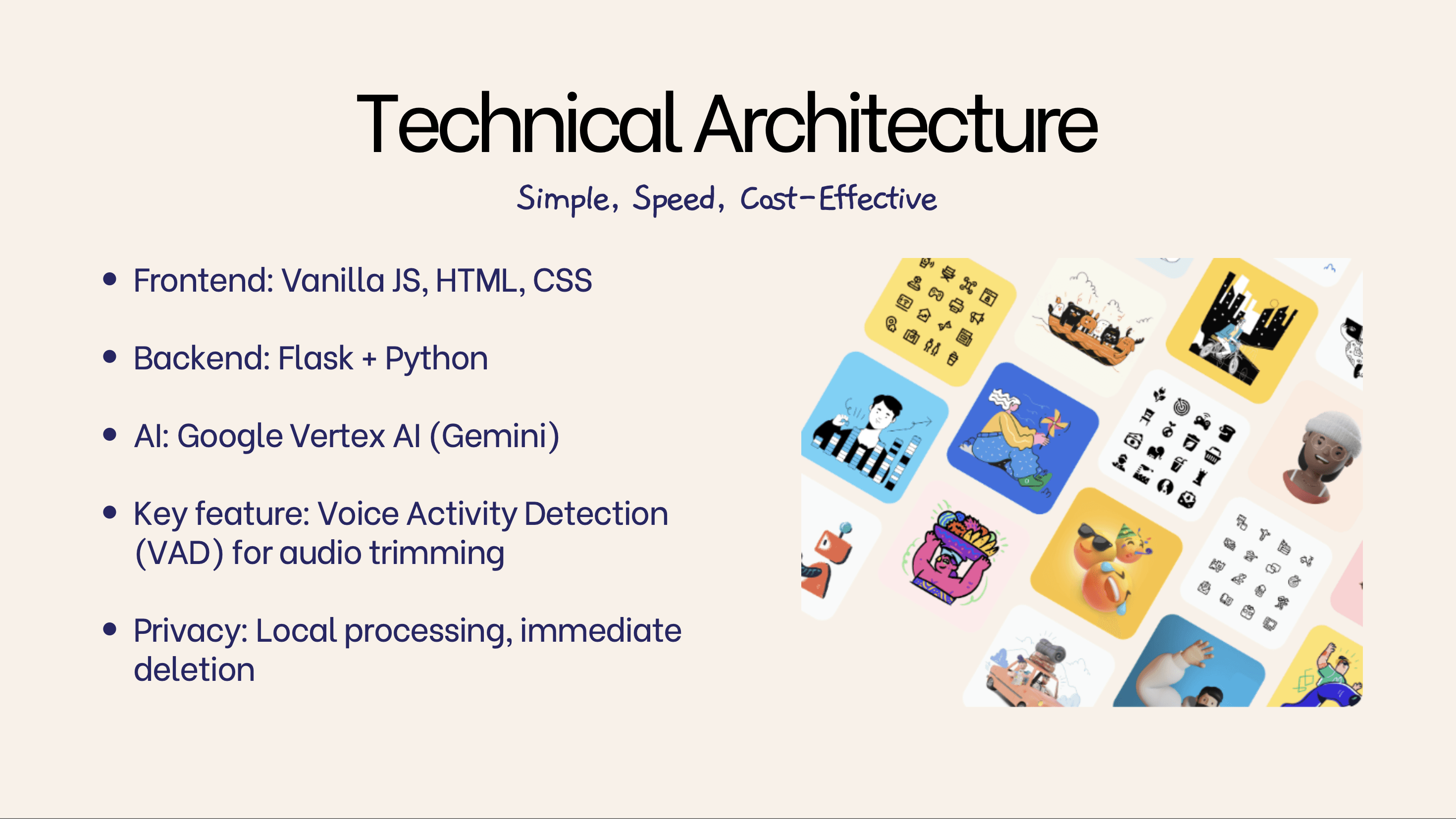
Orato is powered by Google Vertex AI (Gemini), selected for its structured feedback generation and Python backend compatibility. The product was built with Vanilla JavaScript, HTML5, and CSS3 on the frontend and Flask on the backend, a deliberate choice for speed, local audio control, and zero framework overhead.
Privacy architecture
All audio is processed locally and deleted immediately after analysis. No account creation. No persistent history. The local loopback architecture kept raw audio entirely within the user's environment during capture. This was not just a technical decision. It was a trust decision. Users practice more honestly when they know nothing is being stored.
Voice Activity Detection
A custom VAD system was built locally in the browser using the Web Audio API to trim silence before sending audio to the AI. This reduced data payload, improved response speed, and made the product accessible on standard home internet connections.
Prompt engineering
The AI persona was engineered as a "Peer Coach," a friendly mentor who sounds like a fellow student who recently entered the workforce. System-level prompts directed the AI to parse transcripts through the CARL framework, extract direct quotes from the user's response, and generate feedback that felt specific rather than templated.
Testing followed a think-aloud protocol combined with semi-structured interviews across 8 phases from February through April 2026, totaling 17+ participants.
Testing overview
Survey (22 participants, Feb 10-13), In-depth interviews (4, Feb 14-17), In-house prototype test (4 team members, Feb 18), V1 User Test (3, Feb 26), Analog Test (5, Mar 9-14), V2 User Test (2, March 25), A/B Testing Concepts (9, April 20), V3 User Test (3, April 21-22)
What changed because of testing
Video and eye tracking removed after V1 — increased rather than reduced anxiety
Dark corporate interface replaced after V2 — described as "too robotic" and "like software I'd use for work"
Numerical metrics replaced with qualitative indicators — seeing "you said um 23 times" felt like a grade, not coaching
"Ready to record?" confirmation screen added — reduced pre-recording anxiety from 5/5 to 1-2/5
CARL examples rewritten with student scenarios — club leadership, class projects, hackathons instead of corporate professional examples
Setup flow simplified — mode defaulted to Interview Practice, decision points reduced
What users said
"Feedback didn't feel general, it felt specific to what I said."
"Having quotes is really good feedback."
"I'd use this if I had access to it. Helps with confidence and answer preparation."
Orato was presented to peers, faculty, and advisors at CSUEB as part of the MA capstone program in Spring 2026. The final product shipped as a functional web application built with Vanilla JS, Flask, and Google Vertex AI, fully tested across 8 research phases with 17+ participants.
The most significant finding from the project: the barrier to interview practice is often psychological rather than logistical. Students know interviews matter. The tools exist. What stops them from practicing is anxiety, judgment, and the feeling that their attempts are not good enough. Designing for emotional state as a primary constraint, not an afterthought, produced measurably different outcomes.
What I personally learned
The biggest surprise was realizing how much visual design affects whether people trust a tool. When we changed from the dark corporate V2 to the warmer V3 design, users did not just say it looked nicer. They practiced more honestly and felt less anxious. The way something looks directly changes how people use it.
I also had to unlearn the assumption that more precision equals more usefulness. Showing someone "you said um 23 times" was less helpful than saying "a bit rushed." For anxious users, being less exact made feedback more actionable.
If I could start again, I would invest more time earlier in the AI capabilities inside the product itself, specifically role-based question generation tailored to a specific job description and a conversational follow-up mode that feels less like a form and more like a real interviewer.